> I'm with you, but given that I have no control over any of them
We all have a little bit of control over at least housing and transport. Local politics determine land use, and municipalities in the US have consistently voted for more car dependency (leading to more expensive transport) and limited housing construction (leading to more expensive housing).
Local politics aren't really paid attention to, which results in any amount of participation and influence having a relatively large impact compared to state or federal politics.
Can't read the article but I was able to get the summary.
I think evidence in Minneapolis, Denver, Austin, etc. is showing that increasing housing supply can apply downward pressure on rent prices, and subsequently the rent burden of many households as a percentage of their income.
I work/volunteer as a planning commissioner for a suburb of Denver, and allowing more housing to be built is one of the most politically divisive things I've ever had to deal with. People think that if a property is zoned for high density, it will be built overnight. This is not the case unless it's a specific property being changed.
We recently had an apartment building constructed that was zoned for this use almost 20 years ago. The community went into an uproar about this new apartment building, and tried to petition to modify the zoning after permitting was already approved.
This is near a park, has multiple transit stops, walking distance to large employment centers, grocery stores, gyms, and a school. It was a prime candidate for more housing.
Now, since the community has realized that zoning is what controls housing, they have petitioned against following zoning changes, and are basically freezing our zoning code in amber.
It's quite sad, as I see homeless encampments around, people living in their cars, and college grads living with 4 roommates in a house in a suburb. We had a light rail line built through our town a little over a decade ago that connects to Downtown Denver and a few major employment centers, and we still have R1 zoning surrounding some of the stations. We have so much opportunity and it continuously gets squandered by folks that already got theirs.
I live in the Denver metro and have worked on zoning code in other municipalities. This is actually the first I've heard about the "Unlocking Home Choices" plan. This proposal seems like an improvement overall. Some of my thoughts:
> The second concept is to incentivize retention of existing buildings by allowing substantial new construction behind them. Basically, let people cash in on their backyard. This is a significant expansion of the accessory unit rules we have today, and the city’s concept art suggests that it would allow backyard cottages larger than the existing homes (a big change).
This is interesting and I wonder how it would change neighborhood dynamics. I'm not opposed at all because it enables more potential housing options. We have a few of these in the neighborhoods I frequent, but from what I've heard, it's somewhat cost prohibitive in the current form to be worth building one. If this helps make ADUs (maybe the ADU would become the original structure in this case), then that seems like progress.
> The third concept is to allow more units if one unit is deed-restricted to be permanently “affordable.” This is basically the same logic as the first proposal — let developers sell more square footage if they do something residents want: in this case, deed-restrict part of the square footage to be priced below market rate.
This would be helpful for allowing current residents with lower incomes than the newcomers to stay in the neighborhood without taking away an existing dwelling unit from the market. Deed-restrictions kind of concern me, but this seems like a decent compromise to prevent displacement.
> What I don’t see in any of the proposals so far is streamlining and expediting permitting for developers who pursue the path the city wants: more, less expensive homes, rather than fewer, more expensive homes.
Indirectly, the removal of parking minimums from the zoning code should help with this. I think there was also a change to allow single stairways in the zoning which creates a bit more incentive for developers and potentially eases the permit process.
The inspiration came from scattered fragments of my observed needs in life, so it may be hard to intergrate the tools. But I can intentionally do this afterwards. Thank you for your comment.
One of the easiest things to pirate is music. Spotify basically killed mainstream piracy of music by making it cheap and easy to pay for nearly all music.
I used to pirate video games, but Steam basically ended that for me. The sales no longer make it worth it for me to pirate a $60 game, instead, I can buy it for $12 on sale.
For software, I used to pirate Adobe products and Sony Vegas, but there are alternatives for those now.
For something like sports, I think the cost can be hundreds of dollars per season. I watch the NFL and NHL, and to watch every game that I'd like to watch, it would cost me something like $600+ per year. There aren't really viable alternatives. I'd have to get three services to watch all of the NHL games I want to watch, and I don't even know how many services I need for the NFL. Amazon Prime, Sunday Ticket, CBS, Fox? Or cable/YouTubeTV with additional packages?
I'd happily pay $100 or $200 per year to watch all games in a league for a year if it was through a single service. Or a lump sum for all sports. But in the same amount of time to enter my payment information, create an account, etc. I could have easily found a stream and have it on any TV in my house.
For a long time, the US had the money to build things, use them, let them slowly deteriorate, and then abandon them.
It was cheaper to simply let things fall into disrepair, and build shiny new buildings and developments further away from the city center. Rinse and repeat. This is why a lot of inner ring suburbs are filled with strip malls that can't maintain their parking lots, don't have the residential density to support nearby businesses, etc.
It's kind of an interesting development pattern that's been pervasive since the 1950s, and some towns and cities are trying to reverse it with infill.
It wasn't cheaper for any physical reason. It was cheaper because we regulated it that way on purpose.
We've intentionally made it unconscionably expensive to bring anything not built to current standard back into service even in a limited capacity (e.g. sublet a factory into smaller space) because we have because this stuff is mostly the purview of local governments who seem to optimize for some middle-ish ground path of "what makes Karen screech least" and "what makes the professional developers who know everyone in government happiest". There's various exemptions for small residential stuff, but at scale it's all just crap that tends toward "don't allow anything that isn't a new build or a high dollar revitalization project"
Seriously, go to your local zoning board, planning board, etc public facing meetings sometime. The shit they put people who just want to spend huge sums of money to develop stuff, run businesses etc, in your city/town through is beyond the pale. And then some "professional" shows up with a BigCo packet about "here's why our toxic waste dump on the ground floor with a strip club on the top floor can go beside the school" and they can't approve it fast enough. You'll be looking for bulldozers on facebook marketplace before the meeting is half over.
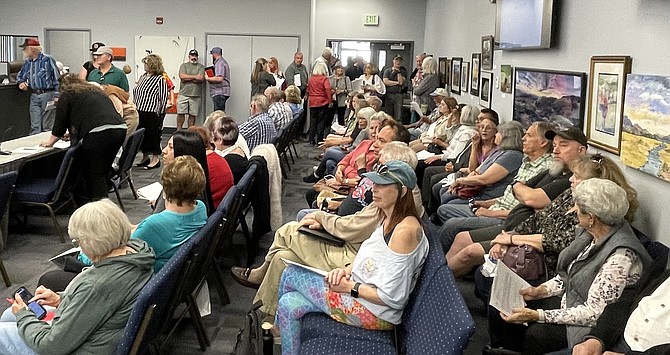
You don't even have to listen to the meeting, just take a look around. Here's one at Carson City[]. Notice something about the demographics? None of those people look like young family in need of their first home or condo. It's people old enough that already have a place, bought during the days while the getting was still good, and are looking to secure their property values. Maybe a few of them had bad luck or had a nasty divorce and lost their house and have no real estate now, but that's unlikely to be the majority of them.
There's almost no overlap between people on and with the means and time to go to planning and zoning meanings and the people who have the greatest marginal utility lowering the bar to owning a business or a home.
Depends on the meeting type. If you go to whichever one involves the relevant committee or board extracting expensive concessions from mundane businesses you're gonna see more younger people because first time business owners tend to be the ones who get screwed the most because they blunder right into all the traps the system has prepositioned for such people.
I watched two brothers in their 30s who'd bought a 12-unit (they lived in it) go rounds with the city over all manner of petty bullshit that can be construed as a legitimate concern on paper but really isn't if you look at the totality of the situation. Ultimately they hired the law firm which was owned by a lifelong developer who was the head of the equivalent board in the next town over (i.e. someone who knew people) and suddenly none of those things were problems anymore.
Why did it fund sprawl? Why didn't anyone choose to develop density on existing sites? We built that stuff just fine from 1870 through the 1940s. What changed? Surely it wasn't the proliferation of government regulation of the development process (and the financials thereof) that caused developers to optimize for greenfield sprawl crap that could most cheaply check the boxes, get the cheap money, get the approvals, be compliant, etc, etc.
> Surely it wasn't the proliferation of government regulation of the development process (and the financials thereof) that caused developers to optimize for greenfield sprawl crap that could most cheaply check the boxes, get the cheap money, get the approvals, be compliant, etc, etc.
I'm sure white flight was a component, as well as subsidizing the auto manufacturing industry and a car centric planning model with federally funded highways.
Road funding is a big reason. Federal, state, and local taxes are used for roads, and more driving. Parking minimums required land to be dedicated to parking, further encouraging car usage for transportation and spreading out development with parking lots in between developments.
> Why didn't anyone choose to develop density on existing sites?
Existing sites would have had to not be developed enough to trigger a rezoning. If a different use was being proposed for land, then a zoning hearing would be needed, and parking minimums would have to be enforced. Thus requiring adjacent lots to be bought and redeveloped into parking unless exceptions were made. You can see remnants of this in some cities where amongst historic buildings and skyscrapers there are large surface parking lots.
> We built that stuff just fine from 1870 through the 1940s. What changed?
Quite a few things. Parking minimums as mentioned, euclidian/single use zoning, etc. I think one of the core things that changed is something that Strong Towns mentioned. Up until the early 1900s, municipal planners would try to project how much tax revenue per acre of land was being generated and how much tax expenditures were made for those areas. Over time, tax per acre or per parcel was deprioritized, and level of service for roads was used as an economic metric. More vehicles in an area means more economic activity (in theory), so municipalities started optimizing for more vehicular movement.
In the end, it was a lot of government regulation that resulted in this. From the federal level, to states, counties, and municipalities. It worked for a large portion of the voting populace, so it was generally favored.


We all have a little bit of control over at least housing and transport. Local politics determine land use, and municipalities in the US have consistently voted for more car dependency (leading to more expensive transport) and limited housing construction (leading to more expensive housing).
Local politics aren't really paid attention to, which results in any amount of participation and influence having a relatively large impact compared to state or federal politics.
reply