Company towns were commonplace, especially near mines in the US in the late 19th-early 20th century. Workers were paid in company scrip that could only be spent at the company store. https://en.wikipedia.org/wiki/Company_town
> Ford might have avoided such tragedies, and the ruinous management of the plantation, if he had sought counsel from specialists in caring for rubber trees or scholars of the Amazon’s capacity to thwart grandiose ventures. But he seemed to abhor learning from the past.
If Ford had sort counsel from experts he would have perhaps been a clerk somewhere. After the fact analysis.
There's an interesting discussion buried here for business and the connection to the "not invented here syndrome". It seems to be a very careful balancing act to decide where to draw the boundary lines of your business vs. sourcing needed items externally.
For example, many people are surprised to find out how little of a car is actually built from scratch by an automobile manufacturer. e.g. the chairs you sit in while driving around are probably built and supplied by an entirely different company you've never heard of! The head unit, but another, the brakes another and so on. How much of a Ford is actually "Ford"?
Car manufacturers seem to have figured this out pretty well over decades and decades, but then we're very inclined to also see the benefits of tight vertical integration. After all, if you buy your rubber from a rubber supplier, aren't you de facto already paying for their company town overhead expenses, transportation, processing and a little profit on top? If you do it yourself, you can eliminate the profit payout, and maybe even optimize some of the production overhead even more!
Apple is a great example, screens, memory, disks, GPUs, batteries and CPUs are all sourced from elsewhere. Apple basically just designs the package and does final assembly of the components. Yet recently Apple has started to get into CPU design. Why?
I think the analysis of this decision would be fascinating to see.
For most of us, in software, we have similar decisions to make with respect to using external libraries, buying services from external vendors and so on. Why buy compute resources from Amazon when you can just build what you need cheaper? Heck, why stop there, why isn't your company writing their own operating system or their own Hard Drives?
There's lots of companies that make the wrong decision early on and end up buried one way or the other later on and it takes heroics to unbury from that decision if at all.
Fascinating. Are there other examples of industrialists from that era building their own towns? I know I have heard of some, but none come to mind right now.
In Brazil there are dozens, most of them English, some examples:
Paranapiacaba, a railroad village at the end of a major inclined place railroad overcoming the coastal range, close to Sao Paulo: https://goo.gl/maps/hE5X7sVhZ4K2
Brazilian Meat Company (today Frigorífico Anglo) in Barretos, the first cold-storage slaughterhouse in Brazil: https://goo.gl/maps/hWuQPGwViF32
Boulder City, Nevada, was built as a semi-permanent town in 1931 to house 5,000 working on the Hoover Dam.
The Wikipedia entry says the city "was exceptionally rare as an example of a town fully planned under government supervision. This is unlike 19th century privately funded company town examples found in the United Kingdom, such as Port Sunlight, or in the United States, such as Pullman, Chicago."
The thing that fascinates me about company and government towns is the rules the residents ended up having to follow. In Boulder City, no drinking, prostitution or gambling. In Saltaire, UK, no hanging washing on a line, or "Gatherings or loitering of more than eight persons in the streets".
Boulder City has retained status as an anti-gaming community despite being not much other than a quiet retiree town these days, and work on the Hoover Dam being complete for a long time now.
In France the Familistère de Guise is renowned, as a kind of socialist utopia for workers, built by an industry leader to house the workers. It's not exactly a "town" but I think it's close enough as it housed 1700 people and took care of their every need.
Alfred Dolge built a factory town near the Adirondacks and gave his workers health care, insurance, and profit-sharing in the 19th century: https://en.wikipedia.org/wiki/Alfred_Dolge
C. Harold Wills was Henry Ford's first employee and right hand man. Henry couldn't pay him initially so he granted him perpetually ten percent of the companies earnings. That became rather expensive and he eventually bought him out.
Wills wanted to build the perfect automobile which had to be built in the perfect town by workers who could walk to work. Having lots of money he bought some farmland near Port Huron, Michigan and created the town of Marysville.
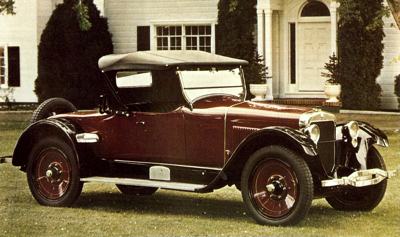
Unfortunately Wills was a far better engineer than a business person. The car, the Wills Ste Claire, was quite innovative but he eventually went broke.
A mathematician (~425BC) who experimented with kites and other lightweight designs for flight. One particularly interesting story suggests he made a wooden dove powered by... Well, we'd suggest it might be compressed air or something of the like.
I'd guess Ford is saying the experiments don't matter, because they didn't take the experiment and make it useful, like those kites made by Mozi and Lu Ban, which were used as early warning systems and similar tasks.