But Moore's Law went out the window over a decade ago. Oh, sure, we're still getting things smaller and faster—but nowhere near the same rate we were before. Nowadays most (not all, but most) of the advances we're getting are in more and better parallelisation, rather than faster performance on each core.
And my (rough, limited) understanding is that based on much more recent projections, it would take several orders of magnitude more computing power to genuinely simulate a human brain than what we have.
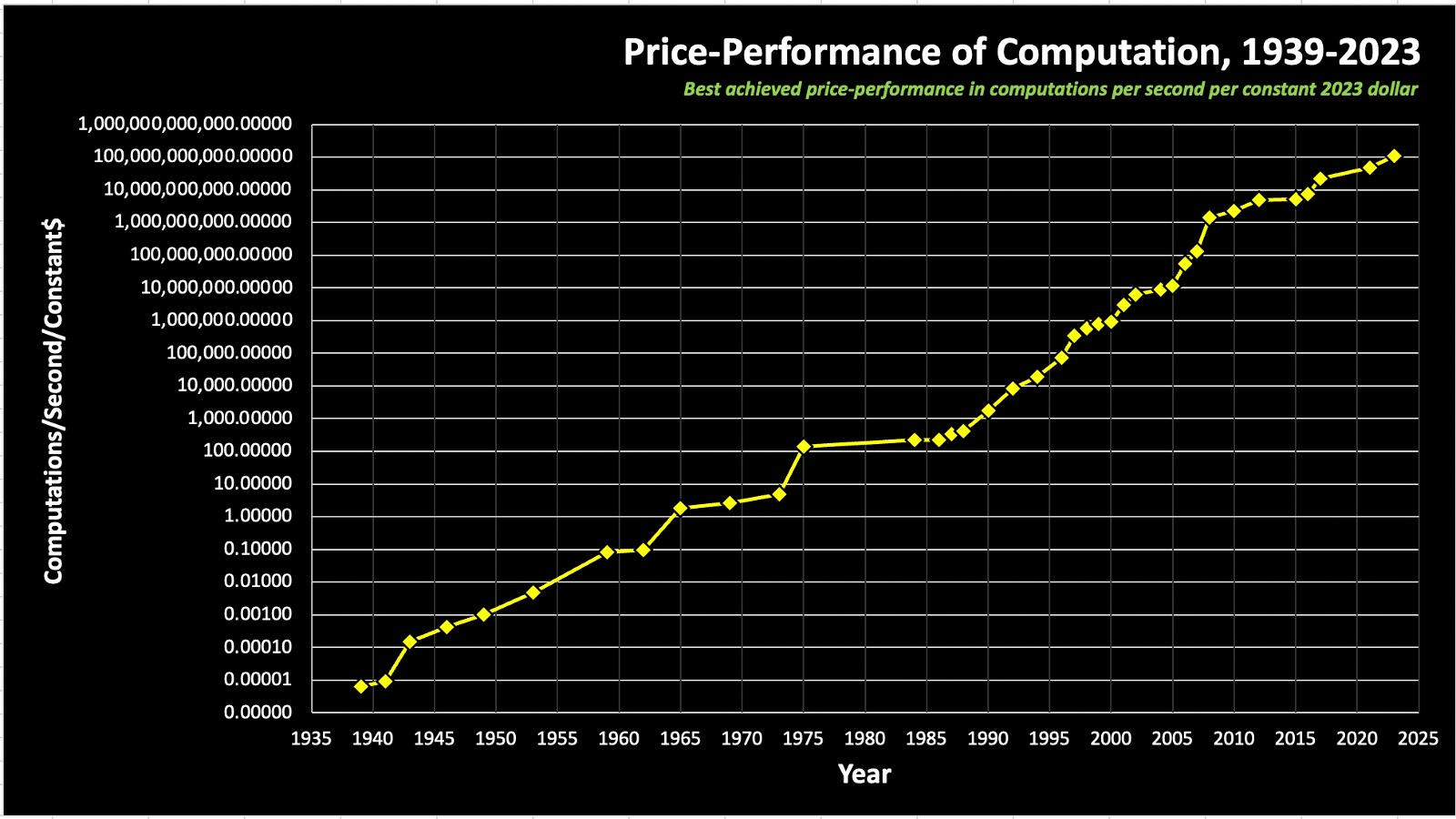
The main Moore's law like metric they track is compute in instructions per second, per dollar. That's kept on a fairly steady exponential for a century or so and doesn't seem to be slowing. (https://www.bvp.com/assets/uploads/2024/03/price-performance...)
We are probably not near simulating a brain but near enough for similar functionality. Moravec estimated it by looking at the retina which was fairly well understood and seeing how much compute was needed for similar object detection etc. in his robots.


And my (rough, limited) understanding is that based on much more recent projections, it would take several orders of magnitude more computing power to genuinely simulate a human brain than what we have.